

Nature put a very healthy food in a small package. Look at figure 5.2 to see nutrients that you get when you eat eggs. Please note that eggs can be white, brown, or other colors. The color of the shell is determined by the variety of the chicken. No matter what the color of the shell, the nutrients inside the egg are the same. Eggs also contain both saturated and unsaturated fats. Eggs, in reasonable amounts, can and should be included in a healthy diet.
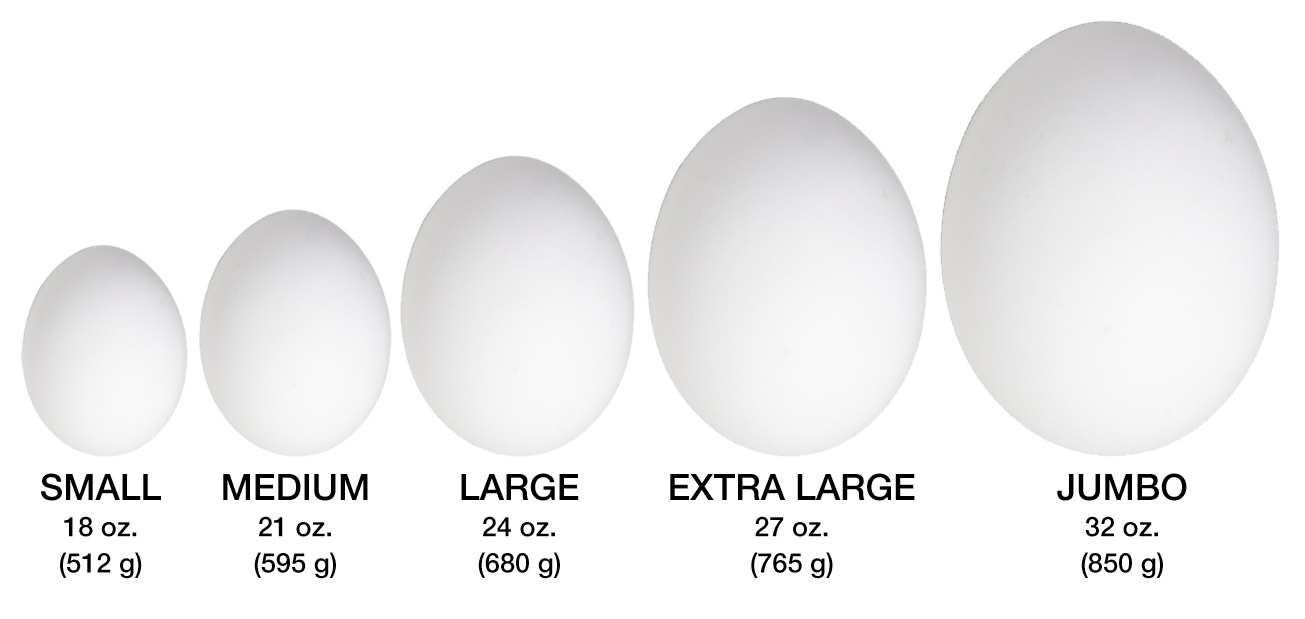
When you purchase eggs in the grocery store you can buy them in different sizes. The size is written on the outside of the carton and is determined by the minimum weight per dozen. Figure 5.3 shows the minimum weight per dozen eggs for each size. When you have a recipe that calls for eggs, and the size of the egg is not mentioned, it automatically means that you should use a large egg.
The grade of the egg is also found on the carton. The grade refers to the quality of the egg. When a Grade AA egg is opened and put on a plate, the white and yolk will spread out to cover only a small area (in other words, the white and yolk will retain much of their original shape, instead of spreading). The yolk will also stand high. This is the highest quality. A Grade A egg will cover a moderate area and the yolk will also stand quite high. With a Grade B egg, the white and the yolk are thinner. Both Grade AA and Grade A eggs are good for cooking things like poached eggs, where appearance is important, or for any general cooking. Grade B eggs are better used for baking. The grade of the egg and the size of the egg are not related. You could have a jumbo egg that is Grade B or a small egg that is Grade AA. Most eggs purchased in the grocery stores are Grade AA.

Look at the illustration of the parts of an egg in figure 5.4. Notice that there are actually two whites. They are the thick white and the thin white. The fresher the egg, the thicker the white. The chalazae (pronounced “kuh-lay-zee”) are the white protein strands that help to hold the yolk in place. Notice the air space at the large end of the egg. The air space gets larger as the egg gets older. When the egg is stored, the air space should be at the top. The egg is packed in the egg carton with the pointed end down, and that is the way that it should stay to help the egg stay fresh longer.
Before you purchase eggs, open the carton and check them. Be sure the eggs have no cracks. A cracked egg can be contaminated with bacteria. Be sure that the eggs are also clean. Eggs are usually purchased in cartons of twelve. These cartons are designed to protect the eggs. You should keep the eggs in the carton when you store them—it protects them from absorbing the odors of other food in the refrigerator and keeps them cushioned. When you return home from the store, put the eggs quickly into the refrigerator because eggs can spoil quickly. They should always be stored in the refrigerator. If eggs are stored properly, they can be kept in the refrigerator for several weeks. Do not purchase eggs from a stand where they are sitting in the sun and not kept cold.
Eggs are a versatile food. Eggs can be hard cooked or soft cooked. They can also be fried in a pan with a small amount of butter or oil. Scrambled eggs, poached eggs, and omelets are also delicious ways to prepare an egg. It is important to remember that eggs will get tough when they are cooked at very high temperatures, so keep your burner on low to medium.
Eggs play an important part in many recipes. Not only do they provide nutrition, but eggs serve other functions in recipes. They can serve as a binder to hold other ingredients, such as in meatloaf. Eggs can also be a thickener, like in cooked puddings. When foods like chicken need coating (usually bread crumbs), dipping them in eggs first helps the coating to stay on. In mayonnaise, eggs serve as an emulsifier. This means that the eggs keep the oil droplets suspended in the water-based liquids. Egg whites can be beaten and used to leaven pastries. Leavening keeps the pastries, like angel food cake, light and fluffy. Just remember that fats will inhibit the formation of fluffy peaks. When you are gathering egg whites to beat them, be sure that none of the yolk gets into the bowl. The bowl must be totally clean and not have any trace of fat in it. When beating egg whites, there are three stages, and these stages are foam, soft peaks, and stiff peaks. You will need to read the recipe carefully to be sure which stage is required. Foam requires the least amount of beating and stiff peaks the most. The soft peaks stage is in the middle.
Many egg recipes are easy to prepare and delicious. You may use the following recipes for scrambled, poached, hard-cooked, or deviled eggs. Or you may choose your own egg recipe.
| Scrambled Eggs | |
|---|---|
| Ingredients | |
| 2 eggs | 1 Tbsp butter or margarine (or use a spray coating) |
| 2 tsp water or milk | |
| Directions | |
| In a bowl, beat the eggs and water or milk with a fork. In a small skillet, melt the butter or margarine on low to medium heat. When the butter or margarine is melted, add in the egg mixture. With a pancake turner, lift and turn the eggs so that the uncooked portion of egg can go under the cooked portion. Continue to cook the eggs for about one to two minutes until they are done. Remove from heat and serve immediately. | |
| Poached Eggs | |
|---|---|
| Ingredients | |
| 2 eggs | water |
| Directions | |
Fill the pan half full of water and bring the water to a boil. Reduce the heat to simmer (cooking just below the boiling point). Break the egg into a small bowl or liquid measuring cup. Slide the egg carefully into the simmering water. Break the second egg into the cup and slide it into the simmering water too. Cook the eggs in the simmering water for three to five minutes or until they reach the desired doneness. Remove the eggs from the water with a pancake turner or a slotted spoon. Add salt and pepper, if you desire. Serving suggestion: Serve each poached egg on a toasted and buttered whole-grain English muffin half. A thin slice of warm ham may be put under the egg. |
|
| Hard-Cooked Eggs | |
|---|---|
| Ingredients | |
| 2–4 eggs | water |
| Directions | |
| Place the uncracked eggs in a saucepan. Fill the pan with enough water to cover the eggs. Turn the burner on and bring the water to a boil. When the water boils, turn it down to a simmer. Cook for 15 minutes. Pour off the boiling water. Leave the eggs in the pan and cover it with cold water. Cooling the eggs quickly stops the cooking and prevents the “green-ring” from forming around the yolk. For soft-cooked eggs the eggs only need to simmer for 8 to 10 minutes. | |

| Deviled Eggs | |
|---|---|
| Ingredients | |
| 6 hard-cooked eggs | 1–2 Tbsp salad dressing (mayonnaise) |
| 1 tsp or less prepared mustard | 1 Tbsp finely chopped dill pickle or pickle relish |
| salt and pepper | |
| Directions | |
| Cut the cooked and peeled hard-cooked eggs in half lengthwise. Carefully lift out the yolks. Mash the yolks with a fork and then add the salad dressing, mustard, and pickles. Add salt and pepper. Stir gently. Spoon the mixture back into the cooked egg whites. Sprinkle with paprika, if desired. | |